Best Practices for Delegating Procurement to a Virtual Design Assistant

For busy interior designers, delegating procurement-related tasks to a Virtual Design Assistant (VDA) can be a total game-changer. While it might feel a bit daunting to hand over certain responsibilities, it's also a huge relief to unload that mental burden. Luckily, many VDAs are seasoned pros who specialize in procurement, handling everything from purchasing to invoicing and order tracking. They've successfully managed these aspects for countless designers, so you're in good hands. With a little upfront effort to onboard your VDA and align on your processes, you'll be set for smooth sailing. Here’s your guide to the best practices for outsourcing your procurement tasks to a VDA!

Software

Even if your VDA has experience with the platforms and project management software you use, every designer operates differently.

  • Walk-Through: Provide detailed training on how you use your software, highlighting specific features and customizations.

  • Provide a Manual: Delegation becomes much more streamlined when you have a manual document you can share and that your VDA can reference anytime.

Access to Accounts & Resources

To perform their tasks effectively, your VDA needs access to various accounts and resources.

  • Project Management Platforms: Grant access to your project management tools.

  • Trade Logins: Provide logins for supplier websites and trade accounts.

  • Cloud Folders: Share relevant cloud folders containing project information.

  • Documents: Provide access to your resale certificate, COI samples, and other necessary documents.

Processes & Protocols

Set clear expectations for processes and protocols so that nothing falls through the cracks, and to avoid duplicate work.

  • Responsibilities: Define who is responsible for each task, such as purchasing, creating and sending invoices, and client communication.

  • Task Frequency: Define how often tasks like order tracking and invoicing should be performed.

  • Templates: Provide templates for Purchase Orders (POs), invoices, and emails.

  • Markup Policies: Explain your markup policies, including percentages and applicable conditions.

  • Tax Information: Share necessary tax-related information.

  • Warehouse Coordination: Outline procedures for coordinating with receiving warehouses.

  • Payment Processes: Detail how payments should be handled and recorded.

  • Delivery Notifications: Establish protocols for notifying clients or receivers about deliveries.

  • Damage Protocols: Set procedures for reporting and addressing damaged goods. 

Communication

Establish the who’s, what’s, when’s, and how’s of correspondence with all involved parties.

  • In-House Communication: Use a consistent method for sharing information within your team.

  • Vendor Communication: Set guidelines for how to communicate with vendors.

  • Client Communication: Define how to handle client interactions, including preferred methods and timing.

Project Briefing

Keep your VDA in the loop about each project by providing essential details.

  • Client Information: Share client names and contact information.

  • Addresses: Provide the project’s site address and accurate shipping addresses.

  • Project Timeline: Outline the project timeline and key milestones.

  • Communication Preferences: Note any specific communication preferences for the client.

Regular Check-ins

Regular meetings are key to maintaining an effective virtual working relationship.

  • Weekly Meetings: Schedule at least a 15-minute check-in each week to discuss progress and address any concerns.

  • Feedback Loop: Encourage open feedback to continually improve processes and collaboration.

Having well-defined processes will help both you and your VDA to work much more efficiently. Getting on the same page from the start makes all the difference when passing off the baton in the procurement phase of your projects. Then, enjoy the weight off your shoulders and focus on the creative aspects of your work!

xx, Danae

Top 10 Ways to Monetize Your Interior Design Business

I get it, full-service design projects are the stars of the show. But branching out a bit can boost your income more than you might think. Diversifying your revenue streams can make your online presence more dynamic and attract a broader range of clients. Plus, exploring new avenues can inject fresh creativity into your workday. Here are ten effective ways to monetize your interior design business:

1. Designer for a Day

Ideal for designers who enjoy quick, impactful projects.

Offer a “Designer for a Day” service where clients can hire you for a set time to provide professional guidance on their design choices. This approach is perfect for clients on a budget and can lead to larger projects in the future​.

2. E-commerce Store

Great for designers with a knack for selecting unique products.

Launch an e-commerce store to sell curated home decor items, furniture, or your designs. This allows you to reach a global audience and generate revenue from product sales, leveraging your taste and expertise in home design.

3. Furniture or Fabric Line

Perfect for those wanting to establish their brand through product lines.

Collaborate with manufacturers to create your own line of furniture, textiles, or home accessories. This can provide continuous income and help set your brand apart in the competitive design market​.

4. Publish a Book

Ideal for designers who enjoy writing and have valuable insights to share.

Writing a book about your design philosophy, tips, and experiences can establish you as an authority in the field. You can publish traditionally or self-publish an e-book to reach your audience. Bonus points if it can double as a beautiful coffee table book!

5. Holiday Decor Services

Great for those who love seasonal decorating.

Offer holiday decor services to clients who want their homes or offices to look festive. This service can be a fantastic source of income and a fun way to engage with clients during seasons that can sometimes otherwise be slower.

6. Virtual Interior Design (E-Design)

Perfect for tech-savvy designers and DIY-friendly clients.

Provide virtual design services where clients send photos and measurements, and you provide design concepts and recommendations. This flexible, scalable model allows you to reach clients far and wide​.

7. Interior Design Workshops

Ideal for designers who enjoy teaching and interacting with others.

Conduct workshops to teach design principles, space optimization, and color coordination. These can be held in-person or virtually, catering to different audiences from homeowners to aspiring designers.

8. Blogging and Social Media

Perfect for designers who love sharing ideas and engaging online.

Start a blog or a YouTube channel to share design tips, trends, and project showcases. Monetize through affiliate marketing, sponsored posts, and ad revenue. This requires consistent content creation but can significantly boost your visibility.

9. Digital Products

Ideal for designers looking to generate passive income.

Create and sell digital products like design templates, mood boards, and e-books. These can be sold on platforms like Etsy or your own website, reaching a wide audience with minimal ongoing effort.

10. Subscription Services

Great for maintaining ongoing client relationships.

Offer subscription-based services where clients pay a regular fee for continuous design support, updates, and seasonal refreshes. This model provides steady income and keeps clients engaged with your services​.

Implementing these strategies can help you explore new markets and boost your revenue streams. Choose the options that align best with your brand and expertise, and start diversifying your interior design business today!

xx, Danae

Get More Clients with Elite Marketing

Are you in the market for more clients? I’ve been hearing from a lot of designers that they are now focusing on their branding and marketing strategies, coming up with an ongoing process that allows them to have a consistent funnel of clients.

We have become well-known in the interior design industry, and while a lot of our clients are looking for assistance with the below, we ALSO offer a variety of marketing services!

Our Popular Services

  • 3d renders

  • drafting

  • construction docs

  • sourcing

  • administrative

  • online business management

  • bookkeeping

  • copywriting

  • social media

Our Marketing Services:

  • marketing strategy

  • branding

  • creating logos

  • web design (Squarespace, Wix, White Label WordPress)

  • graphic design

  • e-commerce

  • SEO

  • advertising

  • influencer marketing

Our virtual assistants have several years of experience with these services. We are noticing an increased demand for marketing services and the great news is, we can help! So, whether you are a new interior designer needing marketing and branding or an established designer who is rebranding and/or needs marketing assistance, please let us know.

We can get you in contact with one of our marketing experts for complimentary calls so that you can determine if our services are right for you!

For more information on those services and some of the experts on our team that offer these services, please see the portfolio section of our website with the link below.

VIEW OUR PORTFOLIO OF SERVICES

 xx, Danae

5 Common Mistakes Interior Designer Make and How to Bounce Back From Them

Like any creative profession, the interior design business comes with a learning curve where trip-ups are just part of the journey. The truth is that so many designers have been there, so the important thing is to learn from our missteps, bounce back, and avoid them in the future. If you’ve found yourself stumbling through some of these, don’t worry! Here’s how to rebound from five typical interior design mistakes and set your practice up for smoother sailing.

1. Cutting into Your Earnings to Maximize Client’s Budget

Mistake: It can be tempting to lower your fees or choose cheaper solutions to stretch the client’s budget further, potentially at your own expense.

Bounce Back: You may be able to fairly mark up other lower ticket items at a higher percentage while remaining true to the agreed budget to compensate a bit. And if it’s the client who keeps pushing boundaries, it might be time to sit down and revisit the budget and scope together. If you’ve already taken a hit on a project, chalk it up to experience. Next time, factor in your desired markup right from the start, so you know the real budget you have to work with for client costs–and stick to it!

2. Skimping on Quality

Mistake: Trying to save some pennies by choosing less expensive materials or furniture can end up disappointing your clients — and they might need replacements sooner than expected.

Bounce Back: Take the time to chat with your clients about the value of paying a bit more for quality that lasts and looks fantastic long-term. It’s all about helping them understand that an investment now can save headaches later. Plus, setting a minimum quality standard for your projects will help you always source from reliable suppliers.

3. Not Tracking Your Time

Mistake: If you’re not keeping an eye on how many hours you’re pouring into a project, you might end up undercharging and overworking.

Bounce Back: It’s never too late to start! Begin tracking your time now, even if it’s midway through a project. Begin with the basics, logging hours per project. As you get the hang of it, break your time down by task within each project. This not only helps with accurate billing but also gives you invaluable insights into managing your time more effectively.

4. Having a Short, Vague Contract

Mistake: A contract that’s too brief can leave too much up in the air, leading to miscommunications and project scope creeping out of control.

Bounce Back: If you’re mid-project and things are getting muddled, try clarifying terms now — many clients appreciate the initiative. For future projects, team up with a legal expert to craft a contract that covers all the bases clearly and comprehensively. This will keep both you and your client on the same page from the get-go.

5. Starting and Stopping Too Many Initiatives

Mistake: You’re trying to stay up to date with industry trends. But frequently changing business strategies or marketing efforts can result in wasted resources.

Bounce Back: Take a step back and evaluate what’s worked and what hasn’t. Stick to one or two new strategies at a time and give them a chance to work before you tweak them. Crafting a solid, long-term business strategy and committing to it will help ensure your efforts are cohesive and impactful. Give each new marketing or business initiative enough time to show results.

Remember, each hiccup is a stepping stone to becoming a better designer, and things are only looking up from here. Keep up the fantastic work—you’ve totally got this!

xx, Danae

A Mini Morning Marketing Session for Interior Designers

Let's face it - marketing might not be your forte. It's tough to navigate the promotional world when your passion lies in creating beautiful spaces. Therefore, we wanted to take a little time this morning to share a few insights on easy ways to effectively market your design business and share some great resources and tools tailored specifically to help interior designers like you with marketing. Ready to dive in?

Building Your Portfolio:

Your portfolio is your visual resume and a great tool for attracting clients. Showcase your best work in a professionally curated portfolio that highlights your design aesthetic, creativity, and attention to detail. Invest in high-quality photography to capture your projects in their best light and consider creating a digital portfolio website to showcase your work online.

Helpful Tool: Maximizing Photoshoots for Interior Designers Mini Guide

This comprehensive guide provides insider tips and tricks for maximizing photoshoots and capturing stunning images of your interior design projects. From styling tips to camera settings to downloadable business forms you need when hiring photographers, this guide will help you showcase your work and create a portfolio that stands out from the crowd.

BUY NOW

Increasing Social Media Presence:

Social media is a powerful marketing tool for interior designers. Use platforms like Instagram, Pinterest, and Houzz to share photos of your work, engage with followers, and connect with potential clients. Consistency is key, so aim to post regularly and use relevant hashtags to increase your visibility.

Helpful Tool: The Hashtag Handbook for Interior Designers

This handbook is your ultimate guide to mastering hashtags on social media. Learn how to choose the right hashtags to reach your target audience, increase engagement, and grow your following on platforms like Instagram and Pinterest. With these expert tips, you'll be able to elevate your social media presence and attract more clients to your interior design business. This handbook also includes over 300 industry-related hashtags! 

BUY NOW

Utilizing Physical Promotional Items:

In addition to digital marketing, don't underestimate the power of physical promotional items to advertise your interior design business. Branded merchandise like tote bags, mugs, and notebooks can serve as stylish and functional marketing tools that help you stay in the front of your client's mind. 

Helpful Resource: Custom Promotional Items

We partner with a promotional item vendor that can find any items you’re wanting to promote your interior design business. Whether you're looking for stylish tote bags to carry your design samples, chic mugs to gift to clients, or elegant notebooks for jotting down design ideas, we can find it! Follow the link below to take our Promotional Product Questionnaire to figure what items best fit your needs.

TAKE QUESTIONNAIRE

By investing a little time into your marketing and choosing helpful tools and resources that can streamline the process, you don't have to be an expert in marketing, you can continue pursuing your passion - designing beautiful spaces, you just get to show it off a little more. 

Happy Marketing! 

xx, Danae

8 Networking Tips for Introverted Designers

Networking can be a challenge for anyone, but it can be even more so for those interior designers who identify more with introverted traits. The thought of engaging in conversations with strangers, pitching ideas, and making small talk at industry events might seem daunting or downright exhausting. So let’s look at why it’s worth the effort, and how to make it a bit easier on yourself.

More than just exchanging business cards, networking allows you to share ideas, gain fresh insights, and stay abreast of the latest trends and technologies. And this can lead to project collaborations, mentorship opportunities, and even friendships. In an industry where reputation and word-of-mouth are invaluable, building a robust network can be your most powerful marketing tool. You're essentially expanding your reach and potential client base without the overt push of traditional advertising. So, while it may be out of your comfort zone, the long-term benefits of networking can far outweigh the initial discomfort. With this in mind, let's dig into some practical, manageable strategies to help you build meaningful connections.

1. Start Online

The digital world offers a comfortable starting point to connect with others. Social media platforms, forums, and online communities dedicated to interior design are great places to begin. You can engage in discussions, share your work, and comment on others' projects at your own pace. Instagram, Pinterest, and LinkedIn, for example, all have promise. You can join interior design groups and participate in discussions. The key here is to be consistent and genuine in your interactions.

2. Prepare Your Elevator Pitch

An elevator pitch is a short, persuasive speech about yourself and your work. Having one prepared can ease the stress of starting conversations. Your pitch should be concise, lasting no more than 30 seconds, and clearly articulate who you are, what you do, and what makes your work unique. Practicing your pitch will make you feel more confident when the opportunity arises to introduce yourself.

3. Choose Smaller Events

Instead of heading straight to large-scale conferences or networking events, why not start smaller? Smaller workshops, seminars, or local meet-ups can be less intimidating and offer a more relaxed environment to connect with others. These settings often provide more opportunities for meaningful conversations and connections that can be nurtured over time. 

4. Be a Listener

One of the strengths of being an introvert is the ability to listen. Use this to your advantage by showing genuine interest in what others have to say. Asking open-ended questions can keep the conversation flowing and take the pressure off you to do all the talking. Listening attentively can help you learn more about the industry, discover new opportunities, and understand how you can offer value to others.

5. Leverage Your Existing Network

Your current connections can be a goldmine for networking opportunities. Reach out to friends, family, and acquaintances who might have connections in the interior design world. A personal introduction can feel more comfortable than approaching someone cold. Plus, being referred by someone they trust can make the new connection more open and welcoming.

6. Follow Up

After attending an event or having a promising conversation, always follow up. A simple email expressing your appreciation for the conversation and your interest in keeping in touch can go a long way. Following up not only shows professionalism but also helps to solidify the connection you've made. It can be helpful to mention something specific from your conversation to remind them who you are.

7. Set Realistic Goals

Before attending any networking event, set a few realistic goals for yourself. It could be as simple as having three meaningful conversations or connecting with a specific person. Setting goals can give you a sense of purpose and make the event feel more manageable. Remember, quality over quantity is key, especially when you're just starting to push your networking boundaries.

8. Take Care of Yourself

Networking can be draining, especially for introverts. It's important to recognize your limits and give yourself time to recharge. Don't feel obligated to attend every event or stay until the end. It's okay to step outside for a break or to limit the number of events you attend within a certain period. Prioritizing your well-being will help you be more present and engaged when you do choose to network.

Networking as an introvert in the interior design industry doesn't have to be overwhelming. Remember, quality often trumps quantity when it comes to networking, so focus on making meaningful connections that align with your goals and values. And who knows? Putting yourself out there might just turn those jitters into unexpected joys.

 xx, Danae

6 Interior Design Risks Worth Taking

Do you tend to play it safe as an interior designer? That’s a fantastic quality to have in many situations. For example, you wouldn't dream of leaving budgets, timelines, or contract clauses up to chance. But growing your business and crafting outstanding designs means knowing when to stick to the rules and when to throw the playbook out the window. Here are six times it’s worth taking a risk, both in running your design business and your designs themselves.

On the Business Side

1. Specializing in a Niche Market

The prospect of narrowing your focus might initially seem counterintuitive, risking the alienation of a broader client base. But here’s the thing - carving out a niche for yourself actually helps you stand out to the perfect clients. Being known as the go-to person for, say, eco-friendly spaces or high-tech offices? That’s gold.

2. Charging for Consults

Asking for money right out the gate can feel awkward and awaken imposter syndrome. But this strategy serves a dual purpose. It underscores the value you bring to the table, ensuring clients are invested from the get-go, and sifts through to serious inquiries, saving you precious time and energy.

 3. Delegating to an Assistant

Letting go of the reins a bit and delegating doesn’t have to mean losing your vision in the mix. It means you get to focus more on design and less on the nitty-gritty. And who knows? An assistant might just bring fresh ideas and energy to the table.

In Your Designs

4. Incorporating Vintage Items

Sure, sticking to the latest trends from popular stores might seem like the safe choice, but sprinkling your designs with a few choice vintage pieces? That's where the magic happens, adding layers of depth and story to a space.

5. Unusual Color Combinations

Neutrals and played-out color combos feel safe, but throwing in an unexpected pop of color can turn a room from "just nice" to "wow". Think a splash of neon in a sea of pastels or a dark, moody wall in a room full of brights.

6. Mixing Patterns and Materials

Yes, there's a fine line between eclectic harmony and chaotic clashes when it comes to blending textures, patterns, and materials. But with a discerning eye, the combination of different woods, metals, fabrics, and more can create a sensory feast.

Taking Smart Risks

So, how do you dive into these risks without sinking? It all starts with having a solid base—like a well-oiled workflow—and then setting aside a little playground for creativity. Allocate a portion of each project's timeline just for trying out new things. This way, you're not running off course; you're exploring potential within reason. Getting your hands on physical samples and leveraging 3D renders lets you test-drive your daring ideas before going all in. And when you're eyeing those bigger business moves? Start small. Do a bit of research into the market, and maybe even chat with a business guru. It's all about smart risks that let your creativity—and your business—soar.

Ultimately, the essence of interior design thrives on creativity, innovation, and a touch of daring. While risks come with their own set of fears and potential setbacks, they also open doors to breakthroughs and professional wins. Maybe the question isn't whether you can afford to take these risks, but rather, can you afford not to?

xx, Danae

Unlock Your Freelance Potential: The Six-Figure Virtual Business Roadmap Mastery Course

The allure of freelance work is undeniable. The freedom to be your own boss, the flexibility to choose your clients and projects, and the promise of financial success—it's a dream many aspire to achieve. But let's be real, navigating the freelancing landscape can be daunting. How do you stand out in a sea of competitors? How do you ensure consistent income while maintaining work-life balance? If you've ever found yourself pondering these questions, then look no further. Our Six-Figure Virtual Business Roadmap Mastery Course is here to guide you every step of the way, whether you are wanting to take your first steps as a virtual assistant or are a seasoned pro looking to grow your side-hustle.

Imagine a Life Where You Can...

  • Be Your Own Boss: No more answering to a supervisor or adhering to someone else's schedule. With our course, you'll learn how to take the reins of your career and carve out your own path to success.

  • Enjoy the Financial Rewards: Achieving six-figure success is not just a pipe dream—it's within your reach. Our course will equip you with the tools and strategies needed to command the rates you deserve and enjoy financial stability.

  • Choose the Clients and Projects: Tired of working on projects that don't excite you? Say goodbye to mundane tasks and hello to fulfilling work. Learn how to attract clients and projects that align with your passions and expertise.

  • Achieve a True Work-Life Balance: Gone are the days of burning the midnight oil and sacrificing personal time for work. Our course will show you how to optimize your workflow, allowing you to achieve balance and reclaim your time.

What You'll Learn

  1. Niche Selection and Branding: Discover how to identify a profitable niche and position yourself as an expert in your field. Build a personal brand that attracts high-paying clients and sets you apart from the competition.

  2. Crafting Irresistible Proposals: Master the art of writing proposals that win clients' trust and convert prospects into paying customers. Learn how to communicate your value effectively and land more projects.

  3. Pricing Strategies for Profit: Set your rates strategically to ensure you're compensated fairly for your work. Strike the perfect balance between profitability and client satisfaction.

  4. Finding and Attracting Clients: Utilize proven strategies to expand your reach and connect with clients who appreciate your skills. Learn how to leverage online platforms and networking opportunities to grow your client base.

  5. Streamline Workflows and Productivity Hacks: Maximize efficiency with time-saving tools and workflows. Discover productivity hacks that will help you take on more clients and increase your earning potential.

  6. Client Relationship Building: Cultivate strong, lasting relationships with your clients. Learn how to communicate effectively, exceed expectations, and turn satisfied clients into loyal advocates for your business.

  7. Financial Management for Freelancers: Take control of your finances and secure your financial future. Learn how to manage your income, budget effectively, and plan for long-term success.

  8. Scaling Your Freelance Empire: Discover the secrets to scaling your business while maintaining quality and client satisfaction. Learn how to delegate tasks, hire subcontractors, and expand your service offerings.

Why Choose Our Course

  • Proven Success: Our instructor, Danae Branson, is an industry expert and is eager to share her insights with you. Benefit from years of experience and learn from her triumphs and challenges.

  • Actionable Insights: Forget theoretical fluff—our course is filled with practical, real-world advice and actionable steps that you can implement immediately. No more guesswork, just results.

  • Community Support: Join a community of like-minded freelancers who are on the same journey as you. Receive ongoing support, encouragement, and inspiration from your peers and mentors.

Lifetime Access:

You have lifetime access to all course materials and updates. Stay at the forefront of the freelance industry and continue to hone your skills as the industry evolves.

Don't let the uncertainty of freelancing hold you back. It’s time to find a life of abundance, flexibility, and creative independence! With our Six-Figure Virtual Business Roadmap Mastery Course, you'll have the roadmap to success right at your fingertips. Enroll today and take the first step towards a brighter, more prosperous future.

Six-Figure Virtual Business Roadmap Mastery Course

Whether you want to become a virtual assistant or are looking to grow your existing virtual business, this course is designed to not only supply you with the knowledge, skills, and confidence needed to succeed as a virtual assistant but also teaches you how to build and run a successful virtual business that can reach the coveted milestone of a six-figure income.

✓ 5+ Hours of Video Content

✓ 60-page Workbook

✓ Templates and Sample Contracts Resources

✓ Facebook Networking Group

✓ Unlimited Lifetime Access

ENROLL NOW


Productivity Hacks That Are Actually Backfiring

When your creativity is on the clock, productivity hacks can seem like the much-sought-after holy grail of efficiency and time management for interior designers. The market is flooded with books and courses promising to unlock the secrets that will finally make all of the facets of your work fall into place. Of course, there's always room for growth, learning, and fine-tuning our routines. But there are some so-called productivity hacks circulating out there that, if not approached correctly, might paradoxically hinder your progress. Let’s look at six examples!

1. Excessive Multitasking

The ability to juggle client meetings, design drafting, and supplier negotiations all at once seems like a superpower. The truth is that, just like we don’t have chameleon eyes, our brains aren't wired to handle multiple tasks effectively at the same time. Research suggests that multitasking can lead to reduced quality of work, increased stress levels, and even a drop in IQ comparable to missing a night's sleep. For tasks that require deep thought and creativity, like designing a living space, focusing on one task at a time ensures the highest quality of work and innovation.

2. Zero Inbox Policy

The famous zero inbox policy is supposed to eliminate the stress of a cluttered email inbox by keeping it empty or nearly empty at all times. While this sounds ideal, the constant checking, sorting, and managing of emails to maintain an empty inbox can become a massive distraction. It interrupts the creative flow essential for interior designers, pulling their focus away from design work to attend to an endless stream of emails. Scheduling specific times for email management can help maintain focus on design projects without the stress of an inbox calling your name.

3. Social Media Scheduling

Hear me out on this one. I’m absolutely in favor of batch-planning your posts with a neat content or editorial calendar. However, an over-reliance on scheduled content risks making your brand feel impersonal and disconnected from your audience. Engaging with followers in real-time, sharing behind-the-scenes glimpses into your design process, and leaving a little room for the spontaneity of real life can foster a stronger, more genuine connection with your audience, even if it means spending a bit more time on social media.

4. Skipping Breaks to Work Through

The myth that working longer hours without breaks boosts productivity is just that—a myth. Especially for interior designers, whose work demands high levels of creativity and problem-solving, taking regular breaks is essential. Skipping breaks can lead to burnout and a noticeable decline in the quality of your designs. Short breaks throughout the day can refresh your mind, boost creativity, and ultimately enhance the quality and productivity of your work.

5. Overusing Digital Tools

Relying too heavily on digital tools for inspiration can limit exposure to tangible elements that might spark creativity. While software and apps can be incredibly helpful, over-reliance on them can stifle creativity. Sometimes, stepping away from the screen and working with physical models, sketches, or just playing with physical samples can spark inspiration in ways that digital tools cannot. Balancing the use of technology with traditional design methods is where it’s at.

6. To-Do Lists

Here’s another example of how it all depends on how it’s done. Creating to-do lists is a basic organization tool. But some designers actually procrastinate more by categorizing and segmenting their to-do’s in different ways when what they really need to do is dig in. Sound familiar? Try prioritizing a few key tasks each day that will make a significant impact on your projects and lead to more focused and high-quality work.

At the end of the day, every interior designer is unique, with different rhythms, preferences, and work styles. Experimenting, reflecting, and adjusting your approach based on personal experience and well-being is key to finding a sustainable and effective productivity strategy. Remember, the goal is not just to do more in less time but to enhance the quality and creativity of your work while maintaining a healthy work-life balance.

xx, Danae

Mastering the Art of Virtual Client Presentations: 12 Key Ways

More and more, interior designers are opting for virtual design presentations, not just for their efficiency but also for the technological tools they offer. Given the crucial role these presentations play in forging client relationships and setting the project's design course, you want to have them down to a science. Today, I’m here to break down how to refine your virtual presentation skills to perfection, ensuring every slide strengthens your connection with your clients and clearly communicates your vision.

1. Choose Your Tools

For crafting those eye-catching presentations, programs like Canva, PowerPoint, Google Slides, and Milanote are some go-to choices. They offer versatility and feature user-friendly design capabilities. When it's time to present, platforms like Zoom, Google Meet, and Microsoft Teams are the frontrunners, all supporting the essential screen-sharing feature.

2. Format for Impact

A 16:9 aspect ratio is your best bet for a seamless full-screen experience across different devices. High-resolution content (think 1920x1080 pixels) ensures your designs are crisp and clear, both on screen and if printed. Discreetly embedding your logo on each slide adds a professional touch without being distracting. And don't forget the power of a strong opening with a cover page and a gracious closing with a "Thank You" page.

3. Tailor Your Templates

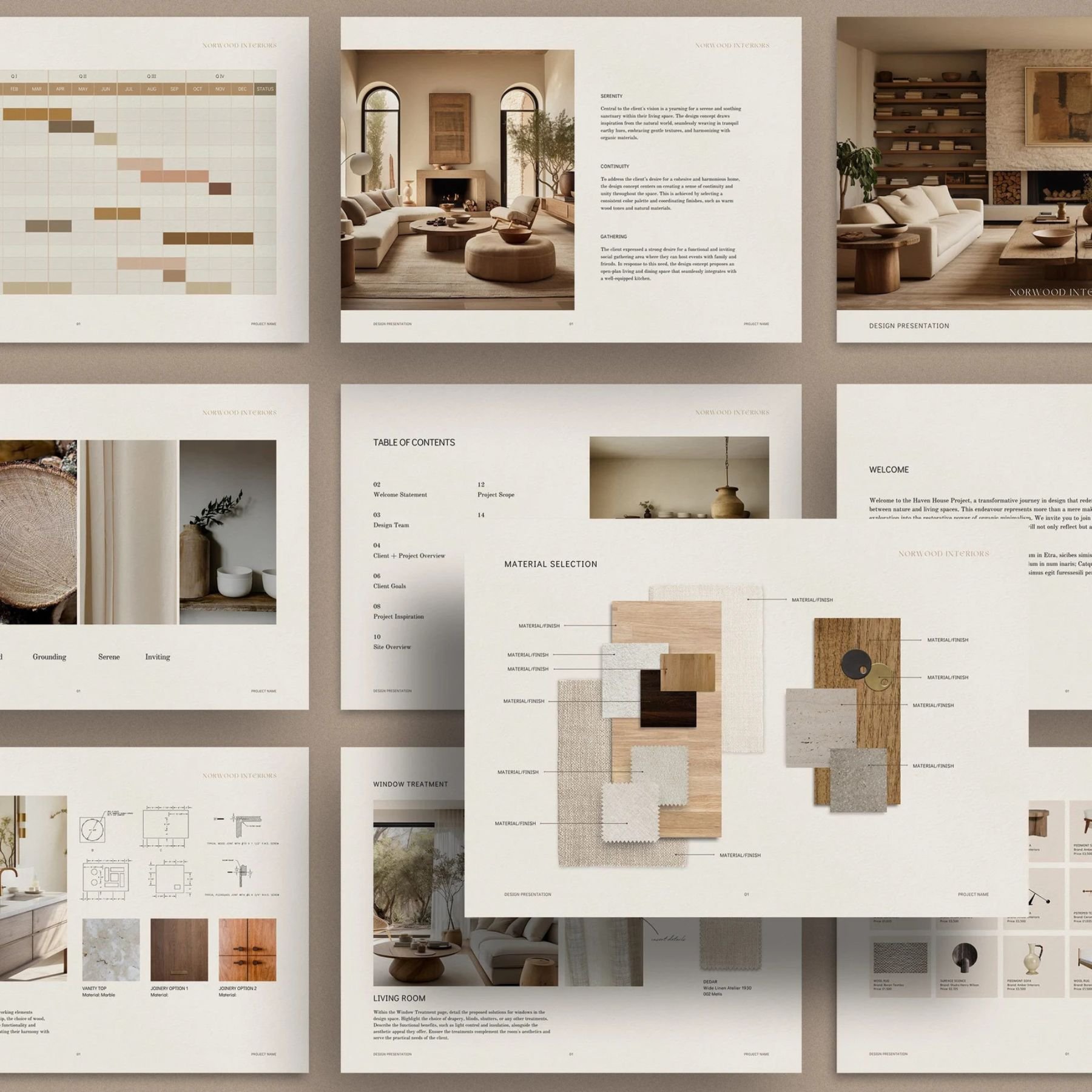
Starting with a well-crafted template ensures consistency, efficiency, and professionalism. But remember, customization is key. Each presentation should be a reflection of the project's unique characteristics, requiring tweaks and adjustments to the template to ensure your design's visual and textual elements are harmoniously presented.

4. Bring Textures to Life

Since clients can't physically interact with the materials, it's vital to include close-up images that capture the intricacies of textures and fabrics, or additional photos showcasing how a material looks under different lighting conditions or when applied in various settings. These visual aids are essential in bridging the sensory gap, allowing clients to appreciate the depth and quality of materials as if they were examining them firsthand.

5. Master the Layout

Achieving a balanced layout involves more than just arranging elements. Utilizing grids ensures everything is aligned and proportionally spaced, creating an aesthetically pleasing arrangement. Implementing a visual hierarchy draws attention to key aspects, and dividing your presentation into clear sections aids in narrative flow. A moderate use of labels and arrows can also be helpful, guiding the viewer's understanding without overwhelming them. Stick to one concept or theme per page to keep the message clear and digestible.

6. Prep Like a Pro

Before the meeting, define your presentation's agenda and objectives. Creating a bullet-point list ensures you cover all necessary points. A quick practice run-through can help avoid any hitches during the presentation, making for a smoother experience.

7. Simplify Your Language

Clear and simple language makes your presentation accessible to all clients, regardless of their familiarity with design terminology. Your tone should strike a balance between professionalism and approachability, showing confidence in your expertise while being open to feedback.

8. Detail Where It Matters

While being concise, don't shy away from detail where it enhances understanding or appreciation of your design. Furniture plans, key elevations, quality images, and even 3D views can elevate the client's understanding. However, limit options for product selections to avoid decision fatigue for your clients. It's your role to sift through the possibilities and present only the best options–and be able to plainly point out the virtues of each.

9. Screen Share the Right Way

Maintaining a polished and organized digital workspace is as important as your physical presentation space. Minimize distractions and protect privacy by closing unnecessary apps and tabs, using a dedicated user profile if needed. Sharing only the relevant application window or tab focuses attention on your content.

10. Feedback Is Key

Making plenty of space for feedback throughout the presentation ensures that no insights are lost or forgotten. Waiting until the end for comments can overwhelm clients and dilute the quality of feedback. Regular intervals for discussion keep engagement high, and it also gives you the chance to refine your approach based on their inputs as you go along.

11. Record the Insights

Make sure to capture all feedback. When a note-taker isn't an option, consider recording the session (with the client’s prior consent) or using transcription software like Otter.ai or the recording features in Zoom and Microsoft Teams. This ensures that no valuable insight is lost and that you can refer back to client feedback as your project progresses.

12. Follow Up

Sending a detailed follow-up email summarizes the discussion and outlines the next steps. It not only keeps the project momentum going but also serves as a clear record of decisions made and actions required, ensuring everyone is on the same page.

By integrating these strategies into your virtual presentations, you elevate not just the visual aspect of your work but also the collaborative and interactive experience with your clients. Each presentation becomes an opportunity to build trust, showcase your expertise, and move one step closer to realizing your client's vision and a design that you can be very proud of!

Happy Presenting!
xx, Danae