
What Is Doing It All Yourself Actually Costing You?
/
What Could You Gain by Letting Go?
Behind every beautiful project is a designer juggling a lot.
Drafting. Sourcing. Renderings. Vendor emails. Client communication. Invoicing. Bookkeeping. Marketing. Proposals... and somewhere in there, you’re supposed to design.
But have you ever stopped to calculate what doing all of those things yourself is actually costing your business?
Your time has a dollar value.
Here’s a simple example:
If your billable rate is $150/hour and you’re spending 10 hours each week on non-billable tasks, that represents:
$1,500/week in potential design capacity = $78,000/year
That doesn’t mean every delegated hour automatically becomes a billable one—but it does show just how valuable your time can be when it’s redirected toward the work that actually needs you.
5 Signs It Might Be Time to Delegate
Not sure whether you're ready for additional support? Sometimes the signs are already there.
You're spending more time managing projects than designing them. Your days are filled with emails, scheduling, vendor follow-ups and administrative tasks instead of creative work.
Your to-do list keeps growing. Even when projects are moving forward, it feels like you're constantly playing catch-up.
You're turning down opportunities. New inquiries are coming in, but you don't have the time or capacity to take on additional projects.
You're working outside normal business hours. Evenings and weekends have become your time to finish the work you couldn't get to during the day.
You're doing work someone else could handle. You're spending valuable hours on tasks that don't necessarily require your expertise.
Sound familiar?
Recognizing where your time is going is the first step toward building a more efficient design business. And the good news? You don't have to delegate everything at once.

You’re Not Paying for the Hour. You’re Buying Back the Hour.
That’s the important shift.
Delegating isn’t just about getting something off your to-do list. It’s about creating room for the work that moves your studio forward.
Vendor follow-ups, invoicing, sourcing and procurement tracking, social media execution, scheduling and client admin can all be handed off—while you stay focused on creative direction, strategic decisions, client-facing design work and relationship building.
And sometimes the return isn’t financial at all.
It’s starting your morning without tedious tasks.
It’s having more face time with clients.
It’s taking on the project you didn’t think you had capacity for.
It’s actually logging off at the end of the day.

Start Small. Think Big.
One of the biggest misconceptions about delegation is that you need to be overwhelmed—or ready to hire a full-time employee—before asking for help.
But sometimes the most effective approach is starting with just one task.
Think about the work you do every week. Which tasks are repetitive? Which ones take longer than they should? And which ones could be completed by someone with the right skills and experience?
Maybe it's outsourcing your next set of 3D renderings. Maybe it's having someone manage vendor communications or keep your social media consistent.
Start by identifying three tasks that regularly take time away from designing. Then consider how much time you could realistically get back by handing off just one of them.
Delegation doesn't have to be a major business overhaul. Sometimes it's simply a smarter way to use the resources available to you.
So…What Could You Hand Off?
Maybe it’s:
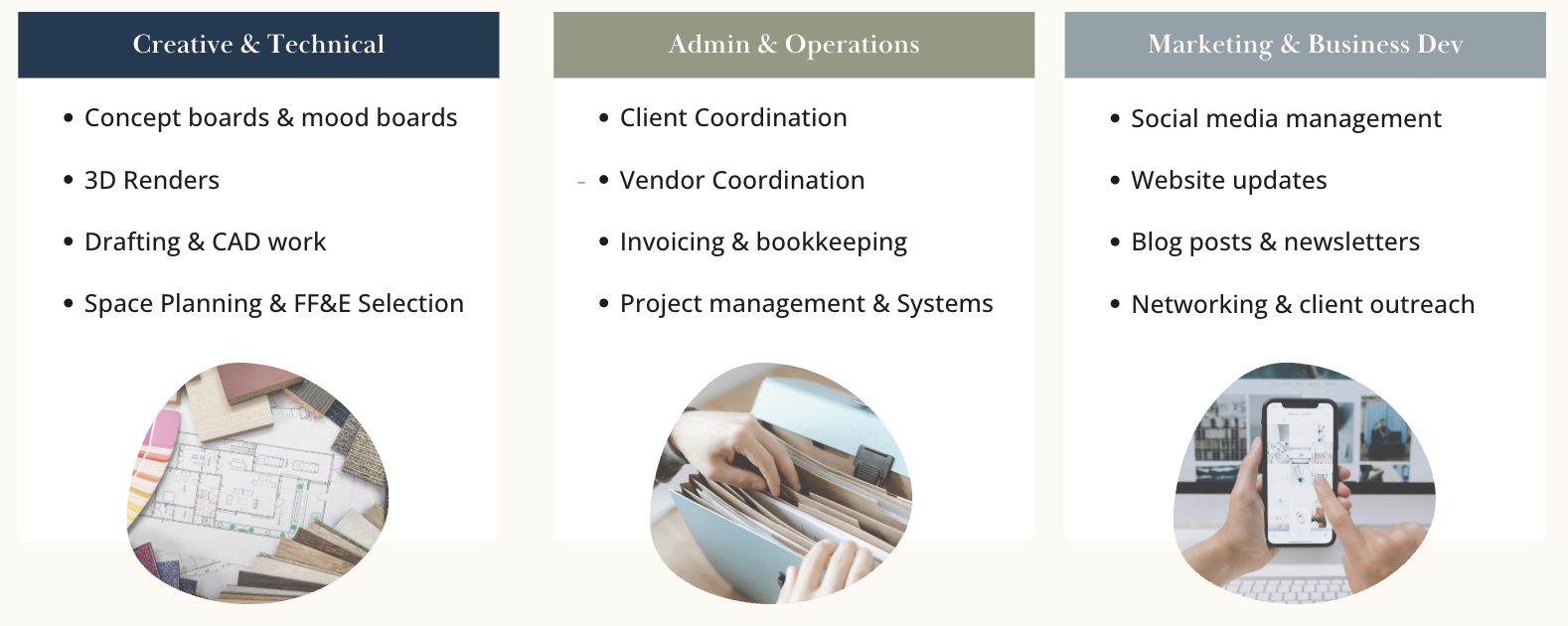
Creative + Technical: CAD, construction documents, 3D renderings, mood boards or concept support
Admin + Operations: scheduling, sourcing, vendor coordination, invoicing or project management
Marketing: social media, content creation, website updates, blogs or outreach
EDA connects interior designers with Virtual Design Assistants who specialize in exactly these areas—and, importantly, are built around the needs of the design industry, rather than general VA support.
You also don’t need to be ready for a full-time hire. Start with a few hours, bring someone in for a busy season or project, mix and match support, and adjust as your studio changes.
The question isn’t just, “What will it cost me to delegate?”
It’s also, “What could I gain if I did?”
The Right Support Looks Different for Every Studio
No two interior design businesses operate exactly the same way. So why should their support look the same?
A solo designer might need a few hours of administrative help each week. A growing studio might benefit from ongoing drafting, procurement or project management support. And an established firm might need specialized assistance during particularly busy seasons.
The key is finding support that complements the way you already work.
And because the needs of a design business can change from project to project, having access to professionals with different skill sets can make all the difference.
Whether you need technical design assistance, marketing support or help keeping daily operations running smoothly, the goal is the same: more time to focus on what you do best.
Elite Design Assistants: Helping designers spend more time designing—and less time doing everything else.