Need More Business? Here’s how to get it!

kam-idris-nylcMEgK8EQ-unsplash.jpg

I realize that at the exact time I’m writing this blog … 10:47 a.m. on Thursday, July 8, 2021, (yes, I’m supposed to be on vacation but I still need to do my treadmill and checking emails and working while treadmilling is the only thing that gets me through my treadmill. Ha!) many designers out there are drowning in work. Which is why we are here – to throw a life vest to those designers and not only help them from drowning but to help them grow and scale their business – and did I mention our contract is on an as-needed basis?

Anyway, enough of the shameless plug, if you are one of those designers I see in groups still trying to get business and in utter shock as to why everyone around you is getting work here are some very helpful things to try!

Give your brand a good hard look. Have a friend or colleague give your website, social media, portfolio and copy a once over as if they are a potential client. Is there a disconnect in your messaging? Are you to vague? Can people easily find your contact information? What do you images look like? Your brand is you, this is why people want to work with you.

  • Can people find your website? You may want to check your SEO and make sure you that are able to be searched based on your location, services, uniqueness, style, etc.

  • Stay busy! You’ve heard the saying, when it rains, it pours. Keep busy improving your brand, your portfolio and your networking and the work will come.

  • Create videos in your down time. I realize half the design industry is saying you MUST do video to stay relevant and the other half would rather eat liver and onions and spend the entire day on the toilet than do video but if you have time … try it. Do something quick and fun and if you need ideas for video, I’ll include some below.

  • Network, network, network. Network with realtors, contractors, painters, mortgage lenders … you never know where you might get business. Try Facebook groups, hand out your business card and local business events, think outside the box and put yourself out there.

  • Try niching down into one specific group. Again, the riches are in the niches, is a popular saying so maybe you are trying to reach everyone and it’s not working – narrow down your target market and go after them. Some designers have a target market of families, empty nesters, singles, luxury clients … and some break it down by style such as coastal, farmhouse, mid-century mod, minimalists, environmentally friendly, etc. who are you most passionate about working for? Who do you resonate with and most connect with? That’s who you want to target.

  • Advertise. You can always try Instagram or Facebook ads. I realize this costs money and to get the most bang for your buck you’d want to work with an experienced social media ad expert.

  • Try a new platform. A lot of designers notice the bulk of their business comes from one main social medium. For example, I hear designers say they are getting most of their business from Pinterest OR Facebook groups OR Instagram OR word-of-mouth referrals. Are those word-of-mouth referrals lucky! The reason they get word-of-mouth referrals is most likely because of the niche they serve. I know a few designers that don’t even have a website!!! That is unheard of and almost absurd in today’s world, however, they got in a niche and showcase all of their work and info on another platform such as Instagram and have been so busy they never had a chance to build a website … or in some cases update and old outdated one. You never know, maybe your target market is waiting for you on a platform you either aren’t spending enough time on or aren’t even on yet.

  • Manifest. I know some people might think this is crazy but I truly believe in manifesting what you want. Envision yourself having all the work you want, believe it, live like you have the business of your dreams and it will come.

  • Collaborate. I have always found that interior designers with a collaborative mindset instead of a competition mindset are way more successful and happier than designers who view every other designer as competition. Reach out to other designers and ask for advice or maybe partner on their overflow work.

As promised, here are some ideas on what to do in videos….

Showcase your strengths – what makes you unique? Maybe you specialize in organization for growing families or luxury items that are also practical. Showcase a few of your favorite design or products.

  • Give a quick tutorial on how to style a coffee table, end table, dresser, shelf, etc.

  • Give a quick tutorial on how the flow of a room should be set up in regards to focal point, etc.

  • Talk about pros and cons of certain materials such as flooring, countertops, lighting

  • Do a fun video about reveal day vs real life

  • Do a day in the life sort of video – use a project in your own home if you have to

  • Go to your favorite home décor store and pull some things together to show how to put together a look

  • Be real, be honest, be yourself and just talk about your business and how you help others

  • Show how drastic a look can change just by swapping out a few materials

  • Review the most popular questions you get and answer them in a series of videos for example – how to choose a paint color, what size of rug do I need, what kind of window treatments should I purchase, etc.

Hopefully, by trying some of the tips above you will see an increase in your business in no time. If you are still struggling and need help, please reach out. We are always happy to help!

XX, Danae

christin-hume-Hcfwew744z4-unsplash (1).jpg

Have you had a chance to take our 2 question survey from last week’s email? This would really help us out. You can find it below. Thanks!

Take our survey

Multi-Vendor Affiliate Programs

I’ve written about affiliates before. They are a great way to make some passive income. If you are already writing blog posts about your designs or posting pins on Pinterest with a ‘Shop the Look’ sort of pin then affiliate vendors are the perfect way to makes some extra money.

How does an affiliate work? You sign up for your favorite vendors affiliate program and then you include your affiliate links for your favorite home décor on your social media. When someone clicks on your affiliate link and makes a purchase, you get a commission! Affiliate links are the perfect way to monetize blog posts, Pinterest pins and social media posts.

Although you will get the largest commission going directly to the vendors to get an affiliate link if you are trying to do this on your own it can get very time consuming. Another, easier way to use affiliate links is by signing up with multi-vendor affiliate programs. These programs allow you to have one affiliate account but use multiple vendors. The commission is typically at a lower rate with these programs but for busy designers the simplicity can trump higher commission rates.

Some of the most popular multi-vendor affiliate programs among interior designers are the following:

1.       Share a Sale

2.       Shop Your Likes

3.       Pepperjam

4.       Amazon

5.       Rakuten Marketing

6.       VigLink

7.       CJ Affiliate

8.       Shop Style Collective


Start making more money today! Please let me know if you have any questions or if you’d like information on how you can work with a virtual design assistant to get your affiliate programs set up for you.

What else would you like to learn from us?

Happy Wednesday, everybody! We’re doing something a bit different this week and we need your help….

Our business is growing quickly and our goal is to continue to accommodate all of our client's needs.

We are currently in the process of transforming Elite Design Assistants to be so much more than just a virtual design assistant service for busy interior designers. We are slowly becoming more of a lifestyle brand, helping interior designers with whatever they need to THRIVE in not only their interior design business, but in life. 

We are currently offering the following services:

  • 3d renders

  • Drafting

  • Sourcing

  • Admin

  • Marketing

  • Social media

  • Web design

  • SEO

  • Bookkeeping

  • Copyrighting

  • Client management

  • Vendor management

  • Project management

  • And help with creating courses, shop the look boards, affiliate marketing, passive income ideas, ecommerce

  • Templates for e-newsletters, Client Questionnaire, Welcome Packet, etc. Shop templates

  • And resources for courses, legal templates, vendors, etc.

What else can we help you with? How can we make your life easier? Our goal is to become your go-to for all things you need. Are you interested in resources and/or help with fashion, travel, fitness, wellness, recipes, finance, real estate, legal or other?

We would love it if you could take our quick survey below, so that we can better serve you. 

We greatly appreciate your feedback!

XX, Danae

SURVEY

Tiny Offers to Create Passive Income

Passive Income.png

I’ve been doing a lot of research on ways to generate passive income by selling digital downloads and some of the research I’ve come across has been very interesting.

One leading digital marketer has been teaching her clients NOT to offer freebies. Yes, that’s right. Even though the popular rule of thumb is to offer a freebie in order to get in front of your target market, this particular digital marketer has found that by offering freebies we are just attracting consumers who are online collecting freebies.

She suggests that we offer tiny offers, whether they be $17 or $27 or $37 … I’m really not sure why they all end in 7 but this is what she recommends. She said that we are more likely to attract our ideal client when we offer them something of value at a small price. They are more likely, than someone who grabbed our freebie, to purchase more from us in the future.

So why does she believe this? When we offer something for free we are potentially attracting way too many of the wrong type of prospects … if someone isn’t willing to spend $27 with us they most likely won’t be willing to spend any money with us. Now I realize that all interior design firms are different and depending on your target market and if you are looking to offer digital downloads this may not pertain to you.

I did find it ironic that she was teaching me about her practice on a Masterclass that she offered for FREE, but that is a discussion for another day. I do know people who have built a successful business offering freebies … offering tiny offers is just an alternative approach to generating more income.

So how does this work? Let’s say you have some valuable information that you are just giving away on your website as a digital download, now you attach a price to it and sell it. I’ve seen designers sell pdfs of design plans, choosing the right paint colors, tips on how to design a room and tips on how to manage their own construction. There are a lot of DIYers out there looking at interior design websites every day and some of them might just purchase your download. After purchasing your download they may just decide to do business with you, and if they don’t, well you still made a bit of cash from their download purchase.

For those of you looking to create passive income, creating valuable downloads and selling them is a great way to increase revenue, increase exposure and increase interest in your business.

Are you ready to start offering a tiny offer? Shoot me an email and let me know how we can help!

XX, Danae

Start offering E-Design Services

2020 and 2021 have been....interesting to say the least...

With spending more time at home, designers have been forced to adapt the the changing world. With e-design being one of the safest options during the pandemic, it has become more popular than ever.

Are you offering E-Design services?

Marketing your e-design service should be an easy sell at the moment. Sign up for my weekly e-mail at www.elitedesignassistants.com and I’ll send you a FREE client/prospect email you can send to your current clients, prospects and email subscriber list regarding your e-design service.

Need more information on e-design for your own business? Here you go!

How does e-design work? (This is a very high-level overview of the process.)

1.       Offer your clients/prospects an intro call and/or zoom meeting to see what their needs are and review your e-design packages. Be sure to explain that in e-design everything is done remotely, so it will not include on-site visits, installation, construction, etc.

2.       Once they choose to work with you, email them your LOA (you may need to adjust this for e-design services) and once it’s received email them a modified version of the questionnaire you normally would in your business. Ask them to include inspiration photos as well as pictures and measurements of the space they want you to design.

3.       Let the designing begin. You can create concept boards, 3d renders and a shopping list for your clients. The shopping list can include links to your affiliate sites for self-ordering or you can offer trade options that you’ll place orders for them as you normally would.

4.       Send your clients the package (concept board, render, shopping list) along with instructions on how to order products and install the design.

5.       Once they’ve implemented your design, ask them to provide after photos so you can use them in your before/after portfolio for e-design. I know a lot of e-designers struggle with getting the after photos so maybe offer some sort of incentive to get those. 😊

6.       Send them a thank you and let them know you’re happy to help them again in another space.

Pricing – Just like in regular design, pricing is very different for all e-designers. Many of them offer a variety of packages. Some ideas of pricing and options I’ve seen are as follows:

1.       Full design per room includes concept board, floor plan, paint palette, shopping list, render, written instructions for installation and a 60 day follow up. Priced anywhere from $700 - $1,000.

2.       Design per room includes everything above EXCEPT render. Priced anywhere from $500 - $650.

3.       Refresh per room – this would be refreshing what they have and styling it, you could still offer a small shopping list of items. Priced anywhere from $300 - $450.

4.       You can also offer online consultations, furniture layouts or shoppable boards for specific styles. And honestly, you can charge whatever you want, of course. This is just what I’ve noticed is the most popular pricing.

There are a lot of resources now on e-design. You can try the Facebook Group called edesign Tribe as a great place to start.

As always, please let me know what you need as I’m happy to help!

XX, Danae

edesign final.png

Client Processes For Interior Designers

It’s going to be a crazy, busy summer so let’s get organized!

I’ve heard from many of you that are getting very busy which is very exciting but can also be very overwhelming so I thought I’d give you some ideas on things you should consider to help you get and stay organized!

First of all, take some time to write down everything you need to do in the coming days, weeks and months. Then crumple up that list and throw it in the trash. I’m so sorry! I’m totally kidding. Please dig that list back out of the trash and from here on out I promise I’ll be serious. J

Block out some time and let’s get to work!

Guidelines

Do you have an operations manual? Have you written down or typed out your business process from start to finish? Creating processes help you stay organized, prevent important details from being overlooked and are very beneficial when delegating tasks.

Write down your business processes and create a manual or guideline that you can use as a reference for all clients you work with and assistants you hire. Include processes for working with clients, marketing, hiring, purchasing, bookkeeping and anything else that is a major part of your business that you feel needs a detailed guide.

I have found that interior designers organize their businesses a little bit differently. Some of them are paper, binder, folder people and others are computer, software, techy people. Do what works best for you!

Today I’m going to write more about client processes and what you should consider having in place, if you don’t already.

Create binders or folders either hard copy, on your computer or in your favorite software program for each client. Now create a To-Do list and schedule for each client. Color code each client and merge the schedule into one master calendar so you have a clearer picture of what needs to be done. But before any of this can be done perhaps you need to take a look at your client processes.

Communication:

Do you have an outline for how communication is handled with clients? Do you have email templates ready to save you time since you most often are sending some of the same emails, whether it’s a response to an inquiry or a welcome email, next steps email, update email or invoice email.

Consultations:

Do you have guidelines on how quickly you need to respond to inquiries and set up consultations? Do you have certain days/times blocked off for consultations only? Do you have a client qualifying process you go through before booking a consultation with an inquiry?

Proposals:

Once you’ve qualified a candidate, had a consultation and are ready to create a proposal, do you have proposal templates on hand? Do you use a formula for figuring out a project timeline and budget? How long do your clients have before they need to respond to your proposal?

Working with Tradespeople/Vendors:

Do you have a list of your go-to contractors, tradespeople and vendors? Do you have a process for connecting with them and lining them up for projects and/or placing orders? How do you schedule installations? Communication and follow up is key and guidelines on these processes are going to eliminate time, headaches and costly errors in the future.

Site Visits:

These processes may have changed due to COVID-19 whether it be the frequency of visits or the manner in which they are conducted. Be sure you have a clear idea of how to schedule and coordinate these as well as how many of these you need for each project. Do you block out time on certain days for site visits?

Reveal Day:

Do you have a checklist and processes for the completion of the entire project? Do you also do styling or take photographs? How do you then present your client with the final invoice?

Running an interior design business is no easy feat! There are multiple moving pieces and a lot of things to coordinate, order, install and consider when working on one project let alone several at one time. Writing down every process and procedure may seem like an overwhelming task but spending a little time now will save you loads of time, money and headaches in the future.

Hopefully, this has given you some things to consider! If you are really struggling with your processes I do know there are courses on this very subject that you can take to really help you get your entire business organized and running in a more efficient manner! Or, I know people who hire an assistant to help get their processes in order as well.

Have a great week! Danae

cp.png

Best Project Management Software For Interior Designers

proj man.jpg

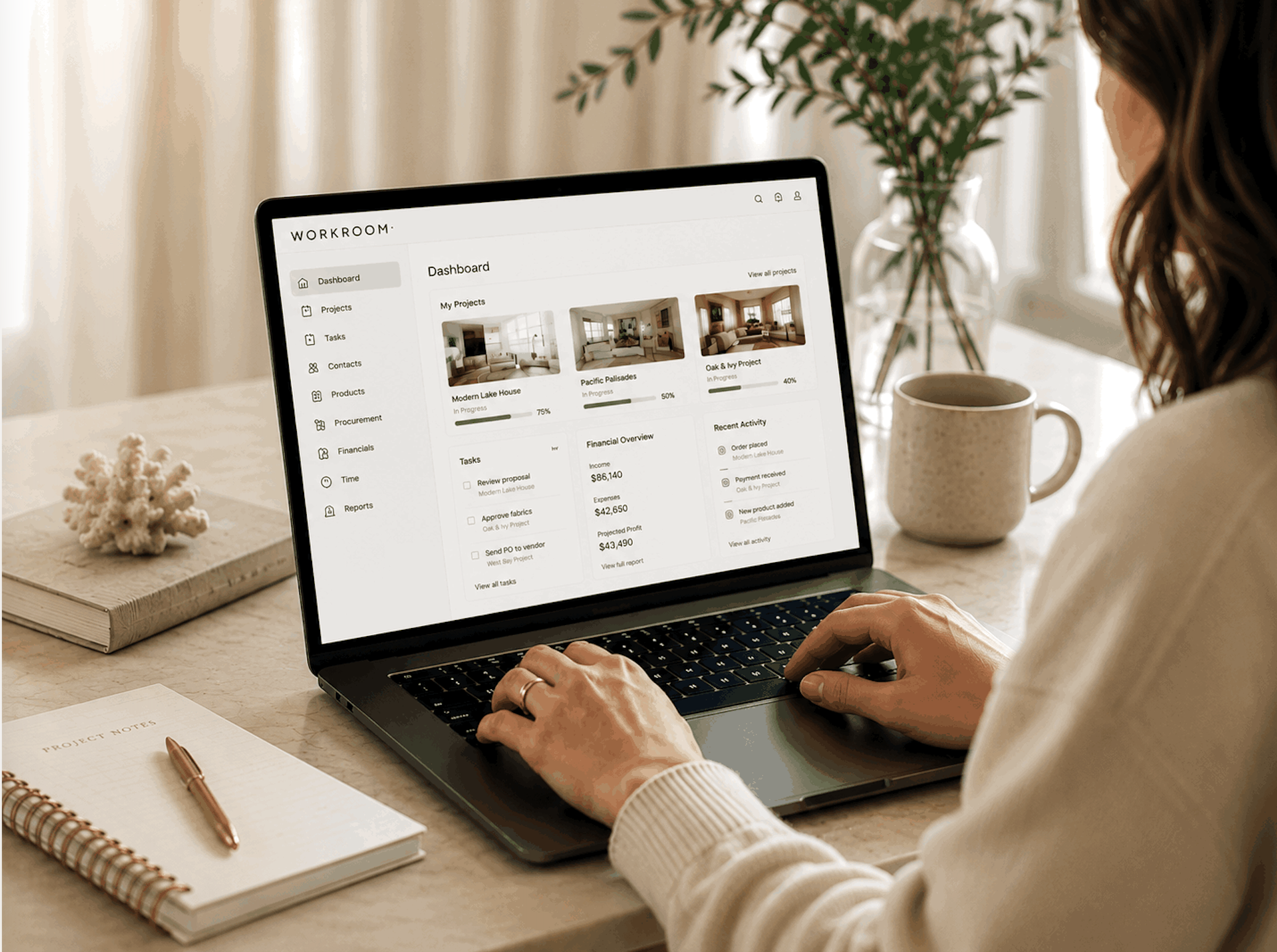
I work with a lot of interior designers and they use a variety of project management software including Ivy, Mydoma, Studio Designer, Design Manager, Designdocs and self-hosted.

Which one is best for you? Hopefully the information below will help.


Ivy
Ivy’s website states - Our platform is designed to take the pain out of administrative tasks and allow designers to focus on the work they love. You don’t just get access to the Ivy platform, but also to our incredible industry resources, and the most powerful and supportive design community.

I’ve been told that Ivy has a low learning curve and is the user-friendlier version of Studio Designer. Ivy works well with direct integration with QuickBooks online including easily accepting credit cards. Ivy allows you to view project timelines without added data entry because estimated ship dates automatically go on the Project Calendar. Ivy will continue to add functionality to make it a strong candidate for the interior designer’s use.

Although it may be user friendly, it does take two programs to do what Studio Designer can do in one. Studio Designer is more customizable; however, Ivy is still very popular among interior designers.  

Pricing: Basic $59/month or $599 paid annually

Essential $99/month or $999 paid annually

Unlimited $149/month or $1,499 paid annually

Plus, QuickBooks fees $40 per month

Try it: Ivy offers a 30-day refund.  www.ivymark.com/

As of March 2018, Ivy sold to Houzz and has some designers questioning their partnership and ethics.  I suggest doing your research on this before taking the plunge into Ivy.  


Design Manager

Design Manager is an all in one software for project management, purchase order tracking, accounting, reports, inventory. Since Design Manager isn’t super user friendly it is often used by established design firms. Their website claims 70% of interior designers prefer Design Manager over QuickBooks.

Design Manager is the leading project management and accounting software for interior designers. Created in 1984 to respond to the requests of local interior design firms, it expanded into a nationwide software company and became one of the first providers of cloud-based design software. Because design firms have specific needs that cannot be answered by conventional software, it is our mission to provide a product that is dedicated to serving the design community. We deliver software that saves time, money, and frustration, while eliminating countless hours of paperwork.


Pricing:

DM Cloud $39.99/month

Pro Cloud $54.99/month

Save 10% by paying annually

Try it: They offer a free trial at https://designmanager.com/


Mydoma

Mydoma is a great organizational tool for your interior design projects.  Many designers love the systems and processes and creating automations so that your business runs easier and Mydoma helps with this.  The Mydoma platform helps with the onboarding process, a place to keep project info (ex: space info, before images, measurements, inspiration images), and a place to collaborate with your clients.  Using Mydoma you are creating an online design studio/project binder to collaborate with your clients.  You can have new clients sign contract, fill out onboarding questionnaire, and send initial payment all within the program.  Great if you do e-design or smaller design packages.

This software is limited if you run a full-service interior design firm.  And the accounting is in QuickBooks, so it requires double entry for products.  

Pricing: $59 per month for Pro, plus QuickBooks fees $40 per month

Try it: Free 30-day trial. www.mydomastudio.com


Studio Designer

Studio Designer claims to be the leading application for interior design professionals. It provides project management and accounting systems for its users. In 2016, it created a Vendor Portal and Client Portal. In 2019, version 2.0 is a new streamline look and efficiencies.

It is a very robust and extensive program for every operation a design firm could face.  This is a one-stop-shop for all your interior designer application needs.  Because of this Studio Designer can feel overwhelming for a novice designer.  It is an accounting program and project management program wrapped up in one.  You can manage your entire business from this program.  Accounting, Expediting, Ordering, Timelines, Reminders, Logistics, Inventory and so much more. 

This program is very technical, and you may need an accountant that specializes in the program.

Pricing: Basic - $35/month

Professional - $45/month

Try it: Studio Designer does not offer a free trial, but they do offer pro-rated refunds, if you wanted to try it for a few days for a few bucks.  www.studiodesigner.com/

DesignDocs

DesignDocs is a total project management and online accounting solution for the interior design industry. Founded by a husband and wife team (a Chartered Accountant and a Designer), DesignDocs provides a full suite of business management tools for interior designers. Additionally, the system gives access to valuable financial reports so designers can gain a strong understanding of their profit margins and identify areas in their business where they can increase revenue. 

The software is ideal for full-service design firms who are looking to increase profits, improve their operational processes, and/or scale their businesses. Pricing: Solo $69/p month or $708 paid annually

Professional: $98/p month or $1,056 paid annually (minimum of 2 users)

Try it: Free 14-day trial. www.designdocs.com


Self-hosted

I know more and more interior designers that are going to a self-hosted type of program. They use landing pages on their websites, Pinterest, spreadsheets and processes to stay organized and on top of their businesses. This isn’t for everyone but if you are looking for a cost-effective way you may be interested in checking out a self-hosted system. Next week, I’ll be writing about how the self-hosted system works and why it might be beneficial to you!

As always, feel free to reach out if you have questions!

Create an online dropshipping store

Dropshipping has become a very popular way for people to run online stores. It enables you to create a site and sell products without having inventory or even paying for the products until they are sold. Interior designers are creating their own online stores using dropshipping.

How to start a dropshipping business:

1. Find a supplier. You will need to find dropshipping suppliers to work with. Oberlo is a marketplace that allows you to find products that you can sell online with dropshipping and according to them the home décor industry will be a $664 billion dollar industry by 2020.

Other dropshippers to consider for home décor: Eastwind Wholesale Gift Distribution, Koehler Home Décor, Park Designs, Wholesale Interiors, Sage Brook Home, Aspire Home Accents, Classic Touch Décor, Designs Direct, LLC, Home Spice.

2. Build your store. You can use Shopify, Squarespace, Weebly, GoDaddy or BigCommece. If you decide to use Oberlo (mentioned above) they work hand in hand with Shopify.

3. Market your website. Create a marketing plan and post your website on social media, your blog, email subscriber list and anywhere else you can to gain exposure.

When looking at marketing your dropshipping business some trends for 2020 to consider are:

*Mobile sales are significantly increasing which means people are using their phones more than ever to purchase products. Make sure your site is mobile friendly!

*Business owners are optimizing their website’s home pages and turning them into product pages. Sell the products front and center instead of having a Shop tab.

*Video descriptions of products are going to start showing up more and more on websites.

*Another random note that may or may not help with creative brainstorming when trying to figure out what to sell on your site – subscription boxes and personalized products are on the rise. Consumers love personalizing items and millennials love subscription boxes. Stay tuned in December for a post about creating subscription boxes for the interior design industry.

A dropshipping store can be as lucrative as you like if you do the marketing, social media and get the word out there. It’s a huge undertaking and if you don’t have the time … well you know where to go :)

To learn more about all things dropshipping, check out this awesome article by Dropshipping Tutor.

https://www.dropshippingtutor.com

VA vs. OBM. What's the difference?

va or obm.jpg

The post-covid world is increasingly virtual and ever-evolving. Perhaps one of the areas of expertise that has skyrocketed during this time is the remotely-based strategy professional known as the Online Business Manager. The role has been around for many years, but is increasingly popular in a virtual world. 

The more commonly known role of a “Virtual Assistant” generally works in tandem with the Online Business manager (“OBM”) but the roles are distinctly different. While a VA is focused on getting tasks done and providing relief, the OBM is focused on improving the “how” you get things done and  managing those processes so the CEO can ultimately remove themselves from the manager function. 

Some organizations are a better fit for the Virtual Assistant support, while other organizations are senior-enough (6 and 7 figure businesses) where they feel the need for a higher level of business support. There are five distinct indications that point to needing a Online Business Manager support your company:

1. You are consistently missing deadlines. If you or your team are struggling to meet quotas, provide excellent customer support, or not move your business forward as quickly as you would like, likely you are in need of an Online Business Manager. The OBM is a master project manager and holds the CEO and their team to deadlines, individual responsibilities, and incentivizes the work needed to move the mission of the business forward. 

2.You do not have enough time for “big picture” tasks. This is perhaps the most common reason business owners bring on an OBM. They find their day to day is swamped with tedious operational tasks and they do not have enough time to dedicate to their CEO role. The OBM will come into your business to implement processes and systems so that your tasks are more streamlined, clear and easy to understand. This should also provide mental clarity and peace of mind knowing everything you need to get done is clearly completed. 

3.You have a team of 2-15 people. While the OBM can still provide relevant support to a solopreneur, there is additional expertise you receive when you have a small team that the OBM can manage and support. Likely your OBM will come into your business and run team meetings, upkeep project management software, provide metrics and reporting, etc. You then can completely remove yourself from the team’s day to day function while relying on your expert communicator to provide you all relevant information that you need. 

4.You have to turn away opportunities because you are so busy! This often happens to very talented business owners. Your business is growing, while your free time is shrinking. An Online Business Manager focused on equal parts high level and granular tasks. Because they will be focused on the implementation of your visions, they can help manage the growing pains associated with more clients, expanded services and growing ventures. 

5.You’re feeling overwhelmed or are not a systems person. Especially for creatives, this seems to be a common pain point for the successful business owner. Some people are not systems-minded individuals, and that IS OKAY! That’s why you may need an OBM. They will help you create processes, implement those processes into the right system for you, and help you and your team manage that system to serve you. You know you have a good OBM when they tell you all about different functions your technology can help you with and support you (without having to do anything manually) that you didn’t even know existed!

Need your own OBM? Contact us today…

XX, Danae

Clubhouse For Interior Designers

Clubhouse for interior designers.jpg

Have you heard about Clubhouse? If not, I’m honestly shocked! It has really taken off since its debut in 2020.

This invite-only platform is an auditory-only app that is for iphone users only. You can hardly scroll social media these days without hearing about it. 

I believe it’s a bit easier to find invites now but when it first came out, you really had to hunt. Rumor says that Clubhouse will be creating a version for Android phones and potentially won’t require an invite but we’ll have to check in on that in a few months and come back with an update.

You can find live conversations on Clubhouse from topics ranging from Health and Fitness to Interior design and anything you can think of in between. Some of the most popular conversations I’ve found are about business, manifestation, and basically any talk given by a celebrity! 

If you have no idea what Clubhouse is, don’t stress. We’ll give you a brief breakdown here:

-Think of Clubhouse as a live podcast system. Nothing is recorded but presenters show up audio only and discuss their topic in front of a listen-only audience.

-Presenters (called Moderators) can invite audience members onto the virtual stage, giving them the opportunity to share their own experiences or ask the moderators any questions they might have.

So how can you utilize Clubhouse as an interior designer? 

  1. Collaboration is key: Similar to a podcast, Clubhouse is a great place to grab a few fellow designers or tradesmen and do a podcast about a specific design subject. So put out your feelers and find someone who wants to join in an online convo with you! The more moderators you have, the better the potential turnout. 

  2. Create a great profile: Put time into this! You have quite a bit of space to tell about your story. Who do you serve? What kind of projects do you like to work on? What subjects around interior designer do you love to talk and teach people about? 

  3. Add a great picture to your profile: Pretty self-explanatory, right? Always pick a professional photo that shows your personality! 

  4. Engage in the app! Join other rooms and participate as much as you can. Share your story in other rooms that are not related to interior design. Share valuable and helpful information whenever you can. I’ve joined rooms before and have had people follow me just for being inside of the room. If you get on stage and talk, everyone will be able to easily access your profile. 

  5. Start your own room: Just use the “create a room” button and then click “add a topic”. Pick something broad so that you can host chats based on many topics. 

Play around with the app and discover all it has to offer! This is the best way to get to know how to use it and all the knowledge you can share through it. 

Have a fantastic day! 

XO, Danae